 ×
×
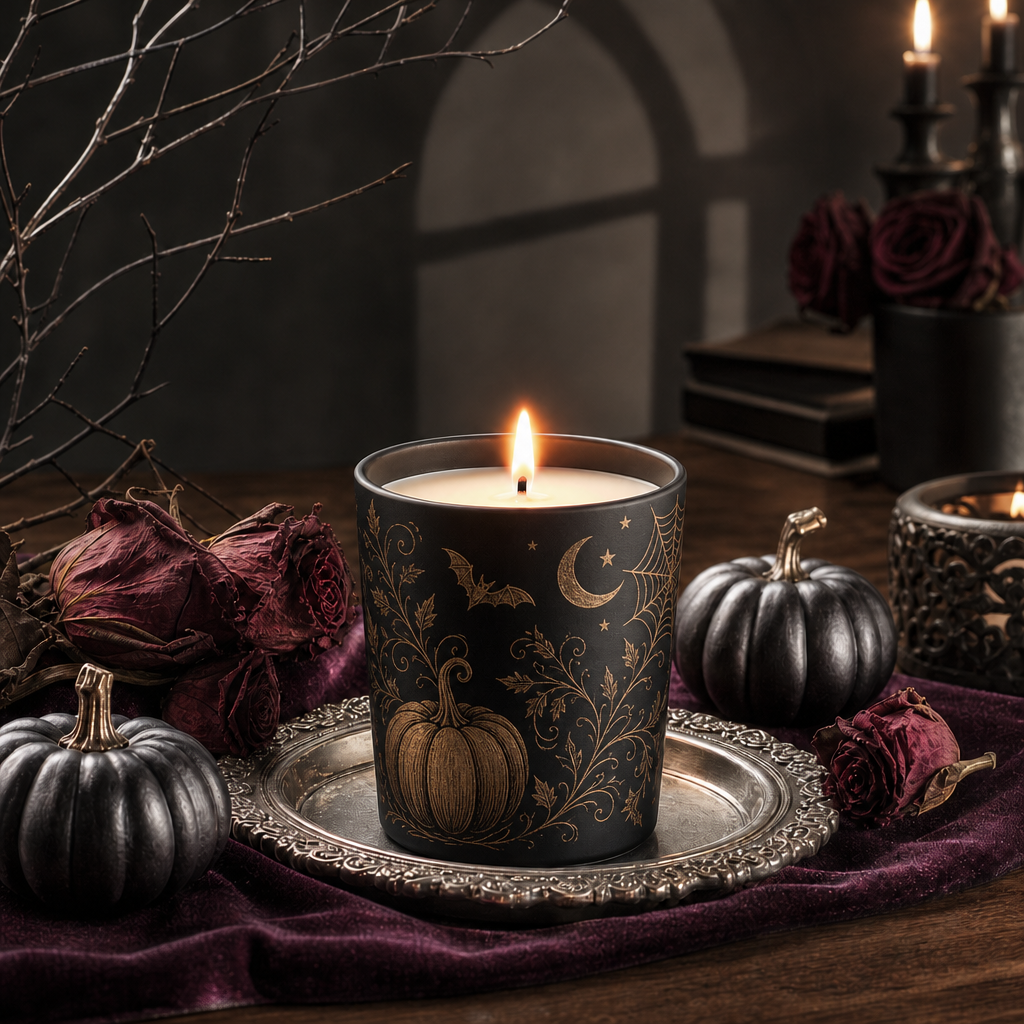
Halloween has grown up. What was once a night of plastic masks and pillowcase candy hauls has evolved into something far more sophisticated—a celebration of shadow, ritual, and dark beauty. Across homes, restaurants, and boutique hotels, the aesthetic of choice is no longer cartoon ghosts and grinning pumpkins. It is Gothic: velvet drapery, tarnished brass, antique mirrors, black lace, and the flicker of candlelight against stone-grey walls.
Yet there is one element that most Halloween decorators overlook, and it is arguably the most powerful of all. Long before your guests notice the candelabra or the raven figurine, they will feel the room. And what they feel is determined, more than anything else, by scent.
At Tabo , we believe that atmosphere is built in layers—and scent is the invisible layer that makes a space unforgettable. In this guide, we will explore the dark aesthetic of Halloween, the psychology of mysterious fragrance, and how a single well-chosen candle can transform an ordinary room into a Gothic sanctuary.
Human beings process the world through five senses, but only one of them connects directly to the emotional and memory centers of the brain. That sense is smell.
When you inhale a fragrance, odor molecules travel to the olfactory bulb and are transmitted almost instantly to the limbic system—the ancient part of the brain that governs emotion, instinct, and memory. Unlike sight or sound, which are first routed through the thalamus, scent has what neuroscientists call "privileged access" to the amygdala and hippocampus.
This is why a particular smell can make the hairs on your arm stand up before you have consciously identified what you are smelling. It is why the scent of woodsmoke can make you feel instinctively watchful. Why the aroma of old leather and dust can make a room feel older than it is. Why certain resins and spices can create a sense of something ancient, ceremonial, and slightly unsettling.
For Halloween, this is not a gimmick. It is a tool.
A room can be decorated perfectly—and still feel flat. Add the right scent, and suddenly the space has depth. It has a history. It has a presence. Guests cannot articulate why, but they will linger, lower their voices, and look over their shoulders. That is atmosphere.
Not all fragrances create a Gothic mood. Floral, citrus, and sweet gourmand scents tend to feel bright, cheerful, and welcoming—excellent for spring, less so for a candlelit séance.
Gothic fragrance is built from a specific palette of materials: smoke, resin, leather, earth, dark woods, dried fruit, and shadowed florals. These notes share certain characteristics. They are heavy rather than light. They are complex rather than simple. They hint at age, ritual, and the passage of time.
Psychologically, these scents trigger a blend of nostalgia, mystery, and reverence. They evoke churches, libraries, old houses, autumn fires, and candlelit ceremonies. They feel sacred and slightly dangerous at the same time—which is precisely the emotional territory Halloween occupies.
Interestingly, this is also why Gothic scents work so well in a candle format. A diffuser spreads fragrance evenly and passively. A candle adds something more: heat, movement, and a living flame. The scent is released gradually, deepening over the evening as the wax pool expands. The fragrance evolves. The room grows darker. The atmosphere thickens.
If you are choosing a candle for a Gothic Halloween, here are the note families to look for—and what each one contributes.
|
Note Family |
Examples |
Atmospheric Effect |
|
Smoke & Fire |
Birch tar, guaiac wood, woodsmoke, cade |
Primal, watchful, ritualistic |
|
Resins & Incense |
Frankincense, myrrh, labdanum, benzoin |
Ceremonial, sacred, ancient |
|
Leather & Suede |
Leather accord, saffron, birch |
Old libraries, worn armchairs, gentlemen's clubs |
|
Dark Woods |
Cedarwood, vetiver, patchouli, oud |
Grounding, mysterious, timeless |
|
Earth & Moss |
Oakmoss, damp earth, mushroom |
Graveyards, forest floors, autumn decay |
|
Dark Florals |
Rose, violet, iris, tuberose |
Elegant, melancholic, Victorian mourning |
|
Spices & Dried Fruit |
Clove, cinnamon, black plum, fig |
Mulled wine, harvest, warmth in the cold |
|
Black Amber & Musk |
Amber, black musk, tonka |
Sensual, lingering, addictive |
A well-composed Halloween candle will layer three or four of these families. A smoke-and-resin blend creates a ritualistic, church-like atmosphere. A leather-and-wood blend evokes a Victorian study. A dark floral-and-amber blend feels like a haunted ballroom. A spiced fruit-and-wood blend captures the harvest side of the season—warm, abundant, and faintly ominous.
A single candle can change a room. Several candles, arranged with intention, can transform it entirely. Here is how we recommend building a Gothic atmosphere step by step.
The single most important step. Fluorescent and cool-white bulbs flatten a space and destroy atmosphere. Turn them off. Replace them with warm, low, directional light—lamps with amber bulbs, or better yet, candlelight alone.
Choose one surface to be the heart of the room: a mantelpiece, a dining table, a console, an entryway. This is where the primary candle will sit—the anchor of the scent story.
Place a single large pillar candle here. Beeswax is ideal, both for its long burn time and for its natural golden glow, which reads as candlelight rather than as a decorative object.
Surround the anchor candle with supporting elements at varying heights:
A cluster of tapers in tarnished or blackened candlesticks
A few small votives in amber or smoked-glass holders
Dried botanicals—eucalyptus, thistles, dried roses, seed pods
Antique books, brass keys, or a tarnished mirror
A length of black lace or deep velvet draped loosely beneath
The goal is not clutter. The goal is layering—so that the candlelight has something to catch, shadow, and reveal.
If you want to intensify the fragrance, place a second matching candle in an adjacent room, or in a hallway. Scent travels, and a consistent fragrance throughout the space creates a sense of a unified world rather than a decorated corner.
Scent needs to move, but too much airflow is the enemy of both fragrance and flame. Close windows and doors, turn off ceiling fans, and keep candles away from HVAC vents. In a still room, the fragrance accumulates and deepens.
One important safety note: Always place candles on heat-resistant surfaces, away from curtains, dried florals, and paper. Never leave a burning candle unattended. If you are hosting a party and moving between rooms, consider extinguishing candles in unoccupied spaces and relighting them as guests arrive.
In Gothic aesthetics, the container matters as much as the candle. Consider:
Amber glass — softens the flame into a deep golden glow and suits apothecary styling.
Matte black ceramic — stark, modern, and dramatic against pale surfaces.
Tarnished brass or aged bronze — evokes church candlesticks and antique hardware.
Smoked or dark-tinted glass — allows the flame to glow while obscuring the wax, adding mystery.
Beeswax pillars, uncontained — the most traditional option, and arguably the most atmospheric. A bare pillar on a brass tray or stone slab looks like something from a 19th-century chapel.
At Tabo , our candles are made from 100% pure beeswax, which burns with a warm, natural glow and a subtle honey undertone that sits beautifully beneath darker fragrance notes. Because beeswax burns longer than paraffin or soy, a single pillar can carry an entire evening.
Scent should not fight your decor. It should complete it. Here are a few pairings:
|
Decor Theme |
Recommended Scent Direction |
|
Victorian mourning |
Dark rose, violet, black amber, lace, pearls |
|
Haunted library |
Leather, aged paper, cedarwood, tobacco |
|
Witch's cottage |
Mugwort, dried herbs, smoke, damp earth, beeswax |
|
Gothic cathedral |
Frankincense, myrrh, stone, cold incense |
|
Harvest masquerade |
Spiced plum, fig, clove, dark woods, amber |
|
Modern minimal Gothic |
Vetiver, black pepper, smoky cedar, iris |
Notice that every one of these directions includes at least one grounding note—wood, resin, earth, or amber. This is what keeps a scent from becoming merely sweet or merely strange. Grounding notes give a fragrance gravity.
Halloween is one night. But the Gothic aesthetic is a season—arguably a state of mind. Many of our customers begin burning their dark scents in early October and continue through the winter solstice, when the long nights and the symbolism of candlelight feel most natural.
There is something deeply restorative about a room lit only by beeswax candles on a cold evening. It slows the pulse. It quiets the mind. It recalls a time before electric light, when the darkness was total and the flame was everything. Halloween simply gives us permission to enjoy what our ancestors lived with every night.
If you want to extend the mood beyond October 31, consider:
Burning a dark, resinous candle during evening reading or journaling
Using a smoky wood scent during winter dinners
Keeping a single pillar lit during quiet weekend mornings, when the low light feels contemplative rather than spooky
The Gothic aesthetic is not about fear. It is about depth—the recognition that beauty and darkness are not opposites, but companions.
One final consideration, and it matters more on Halloween than any other night. When you fill a room with candles and close the doors, you are concentrating whatever those candles release into the air.
Paraffin candles, made from petroleum byproducts, can release volatile organic compounds when burned. In a sealed room with several candles, that adds up. Pure beeswax burns differently: it produces virtually no soot, and it releases negative ions that bind to airborne particles such as dust and dander, effectively cleaning the air as it burns.
For an evening spent in a darkened room with the windows shut, this is not a small detail. It is the difference between an atmosphere you enjoy and an atmosphere you endure.
Halloween invites us to explore the darker side of beauty—velvet and smoke, candlelight and shadow, the thrill of the unknown. But the deepest part of that experience is not visual. It is atmospheric. It is the feeling that settles into a room when the lights go out and something else takes over.
A single candle can do that. Not because of its shape or its label, but because of what it releases into the air and what it awakens in the mind.
This Halloween, do not stop at the decorations. Build the atmosphere from the inside out. Choose a scent with weight—smoke, resin, leather, earth. Place a pure beeswax pillar where the light will catch the shadows. Turn off the overhead lights. Close the door. And let the room become something else entirely.
At Tabo , we craft our candles for exactly this purpose: to turn ordinary spaces into places with presence. We invite you to explore our collection of dark, atmospheric fragrances and discover how much a single flame can change a room.
Waiting for our long-terms and friendly cooperation.

 EN
EN


