 ×
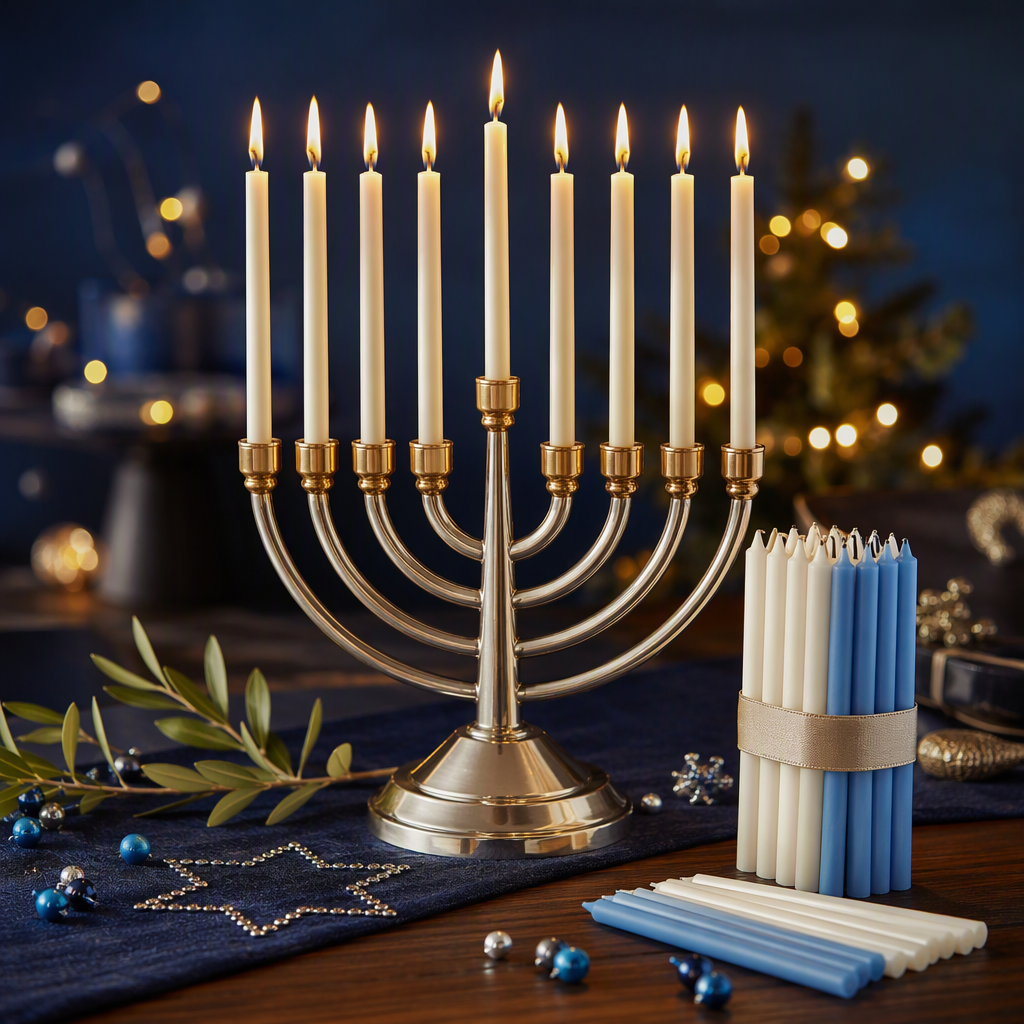
Hanukkah is a holiday built on a single, repeating act: lighting a flame. For eight consecutive nights, Jewish families around the world kindle the menorah, adding one light each evening until the entire candelabrum blazes. It is a ritual of accumulation, of hope growing night by night, of darkness being pushed back one small flame at a time.
But behind that simple act lies a world of detail: the order of the lighting, the role of the shamash, the choice between oil and wax, the fit of the candle in the holder, and the question of what the flame is actually made of. For anyone who wants to honor the tradition with care — and for retailers and gift-givers who want to offer something worthy of the occasion — understanding these details transforms a routine purchase into a meaningful choice.
At Tabo, we craft our candles from 100% pure beeswax, a material that meets the highest standards of ritual purity while burning cleaner and more beautifully than conventional alternatives. In this guide, we explore the traditions behind the Hanukkah lights, the practical considerations for choosing menorah candles, and why the material of the flame matters more than most people realize.
The Hanukkah menorah, or chanukiyah, holds eight lights arranged in a row, plus one additional holder set apart for the shamash — the “servant” candle used to kindle the others。The shamash is not counted among the eight; it exists to serve, and it is kept visually distinct, often raised above the rest.
The procedure is precise, and it is the same every night.
Placement: Candles are placed in the menorah from right to left, adding one new candle each night. On the third night, for example, three candles are placed in the three rightmost positions.
Blessings: Before lighting, two blessings are recited each night. On the first night of the holiday, a third blessing — the Shehechiyanu, a blessing of gratitude for reaching this season — is added.
Kindling: After the blessings, the shamash is lit, and then it is used to light the other candles from left to right. The newest candle — the one added that night — is lit first。The candles must have enough fuel to burn for at least half an hour after nightfall.
Shabbat adjustments: On Friday afternoon, the menorah is lit before the Shabbat candles, which are lit earlier than usual, before sundown. Longer-burning candles or additional fuel are used to ensure the lights remain lit into the Shabbat evening. After Shabbat, the menorah is lit only after nightfall and the Havdalah ceremony.
This rhythm — placing right to left, lighting left to right, adding one light each night — is not arbitrary. It reflects a theology of increase: we do not diminish holiness, we add to it. Each night is brighter than the last.
Jewish law is remarkably permissive about what may be used to light the menorah. The Mechaber rules that “all oils… are kosher for Ner Chanukah” — any fuel that draws properly into a wick and burns with a clear, steady flame is acceptable。The Rama adds that wax candles are also permitted, and notes that their flame is “pure and clean like that of oil”.
So the choice is not a matter of permissibility. It is a matter of quality — of what kind of light you want to bring into your home, and what you want to be releasing into the air your family breathes during eight nights of indoor burning.
Paraffin wax is the most common candle material in the world, and it is what most inexpensive Hanukkah candles are made from. It is a byproduct of petroleum refining: inexpensive, easy to color, and easy to mold.
But paraffin has a legacy that sits uneasily with the spirit of the holiday. Petroleum-based candles “leave us with a legacy of toxins, including soot and black smoke, products of burning fossil-based fuel.” These can be respiratory irritants, and in a room where candles burn for hours each night — often with windows closed against the winter cold — that exposure accumulates.
There is also a practical concern. Paraffin soot can stain silver, metal, and antique menorahs — heirlooms that families treasure across generations.
Beeswax is the oldest candle material in human history, and for Jewish ritual use it carries a particular resonance. The Talmudic discussion of candle fuel centers on purity: the flame should be clear, the fuel unadulterated, the light fit for sacred purpose.
Beeswax meets that standard on every level.
It is kosher by nature. Beeswax is considered kosher provided that no non-kosher solvents are used in its processing and it contains no non-kosher additives. Pure, unblended beeswax processed with water and nothing else satisfies this requirement。When a candle carries a kosher certification, it confirms that the entire production chain — fuel, wick, and process — meets the standards of kashrut.
It burns cleanly. Pure beeswax produces a soft, steady, low-soot flame that does not stain silver or ceramic menorahs. It is free of the petroleum paraffin that produces stubborn black soot.
It releases a natural fragrance and negative ions. Pure beeswax carries a mild, native honey aroma and releases air-purifying negative ions as it burns, creating a calm atmosphere that is safe for children, elders, and guests with asthma or scent sensitivities.
And it burns longer and brighter than paraffin, giving you a flame that lasts through the required half-hour and beyond without guttering.
If you are choosing beeswax candles for ritual use, read the label carefully. The legal threshold for labeling a product as “beeswax” is often only 51% beeswax — the remainder can be paraffin or other waxes。For a candle to carry the full benefits of clean burning and kosher purity, look for 100% pure beeswax, ideally with kosher certification.
The most common mistake in buying Hanukkah candles is assuming that “standard” means “universal.” It does not. A candle can look correct and still fail in the holder — sitting loose and tilting, or too tight and cracking the socket.
Before buying a box, check your menorah‘s sockets: their diameter and depth. A loose candle can tilt the flame toward a curtain or drip wax onto the surface. A candle forced into a socket can crack the holder or become unstable.
Most standard Hanukkah candles fall within a narrow range: roughly 9–10 mm in base diameter and 10–15 cm in height。Many quality producers offer tapers at approximately 1 cm diameter × 14 cm length, designed to fit mainstream nine-branch menorahs with proper space reserved for the shamash。But “standard” is not a measurement — confirm the fit with your specific menorah.
The candle must burn for at least half an hour after nightfall。A candle that gutters out early does not fulfill the requirement. Typical wax Hanukkah candles are designed to burn for approximately 30 minutes, but quality varies.For Friday nights, when the lights must burn longer to honor Shabbat, choose longer-burning candles or use additional fuel.
A good practice: test one candle from a new box before the holiday begins. Light it, let it burn, and confirm that it stays upright and lasts the full required period.
Eight nights, plus the shamash each night, means a minimum of 44 lights for a single menorah. A box of 45 candles is the standard retail quantity for exactly this reason — it provides the full holiday with one spare for breakage or error.If multiple family members light their own menorahs, multiply accordingly.
Some families prefer olive oil, following the mitzvah min hamuvchar — the preferred practice, since the miracle of the Temple occurred with olive oil。Oil cups connect more directly to the traditional narrative and can produce a controlled flame, but they require measured filling, stable cups, correct wick placement, and spill control.
Candles offer a simpler nightly setup with fewer components, a wide range of styles, and easy visual confirmation that each light is seated upright. For many households — especially those with children or guests — the practicality of candles makes the ritual more sustainable night after night.
Whichever you choose, the important thing is consistency: do not mix oil and wax in the same menorah on the same night, as the differing light diminishes the aesthetic unity of the mitzvah.
The Hanukkah lights are meant to be watched. The tradition specifies that they are not to be used for ordinary purposes — not to light a room, not to read by, not to work by. They are holy lights, set apart for contemplation.
That same principle applies to safety. The menorah should stand on a stable, nonflammable surface, away from curtains, shelves, and anything that can catch fire. Children should be supervised. Flames should never be left unattended.
If you are lighting in a setting where open flame is not permitted — a school, a care facility, a hotel, a public venue — battery-operated or LED menorahs remove the hazard entirely. They do not produce the same physical flame, so confirm the observance policy of the venue or community before treating them as an equivalent.
For home observance, the flame is the point. And a clean-burning, well-made candle makes that flame something you can watch with peace of mind.
Hanukkah is also a season of giving. A box of beautifully made beeswax Hanukkah candles is a gift that fits the holiday precisely: it is useful, it is beautiful, and it carries meaning beyond the object itself.
For families, a 45-count box of pure beeswax tapers ensures the full eight nights without a last-minute scramble. For hosts and hostesses, a smaller set paired with a simple brass or ceramic menorah makes an elegant and thoughtful offering. For children, colorful hand-dipped or frosted beeswax candles add a note of festivity while remaining clean-burning and safe for indoor use。-38
And for anyone who values hiddur mitzvah — the beautification of the commandment — a candle that burns brightly, cleanly, and without staining the menorah is its own form of reverence.
The Hanukkah lights are small. One flame on the first night, two on the second, eight by the end. They are not meant to illuminate a room. They are meant to illuminate something else — memory, faith, resilience, the stubborn persistence of light against darkness.
If that is what the flame carries, then the material of the flame deserves the same care.
Pure beeswax burns cleanly, carries a soft natural honey warmth, respects the heirlooms it is placed in, and meets the standards of kosher purity that the tradition asks of sacred light. It is a small choice with a long reach — into the air your family breathes, into the menorah you will pass down, and into the meaning of the ritual itself.
At Tabo, we craft our Hanukkah candles from 100% pure beeswax with lead-free cotton wicks, kosher-certified and designed to fit standard nine-branch menorahs. We invite you to light your eight nights with a flame that honors the tradition it serves.
Chag sameach. May your home be filled with light.
Waiting for our long-terms and friendly cooperation.

 EN


