 ×
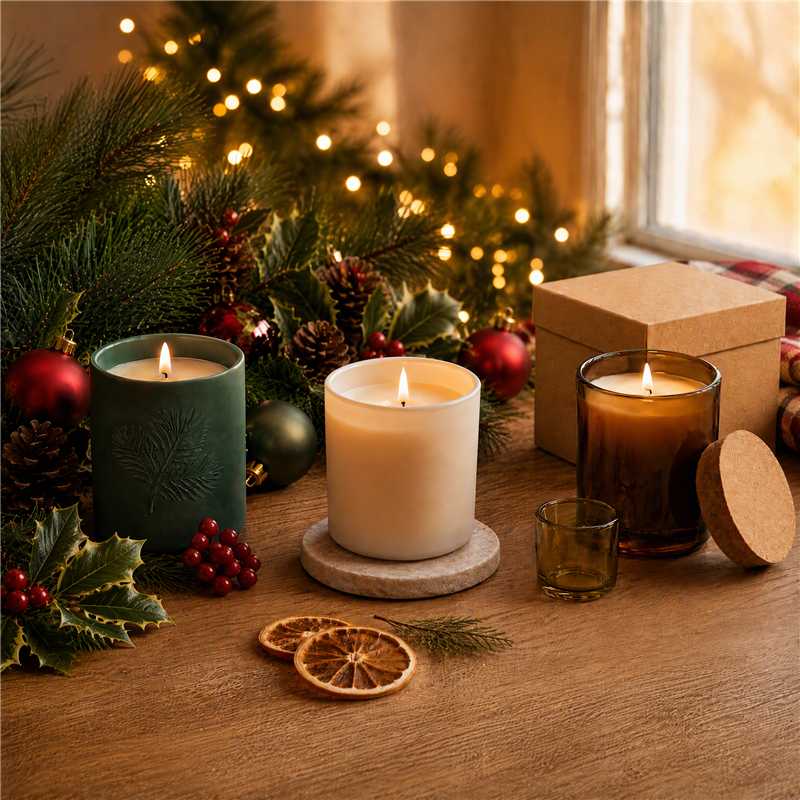
The Christmas candle market has entered a new phase. For years, the formula was reliable: a green jar, a pine-scented label, a bow on the lid. It sold because it was familiar. But the 2026 holiday season shows something more interesting happening. The familiar is still there—pine remains the undisputed center of Christmas fragrance—but it is being reworked, deepened, and held to a higher standard. At the same time, sustainability has moved from a checkbox on a brand deck to something you can actually see, touch, and smell in the product itself.
At Tabo , we watch these shifts closely, because they shape what our customers ask for and what we choose to make. Here is our preview of the scents and design directions defining Christmas candles in 2026.
Market data leaves no ambiguity. Pine and fir is the number one Christmas candle scent, described as the “classic, universal best-seller” with a stable trend direction. Pine is the scent of Christmas: nostalgic, fresh, instantly recognizable. Consumers do not have to think about it—they know what they are getting.
But the more telling movement is happening one layer down. Balsam fir is the fastest-growing fragrance in the evergreen category, with search volume up 15% year over year, and it is being positioned in premium and “natural” candle lines at higher price points. The reason is simple: a growing segment of consumers finds standard pine a little too “candle-y,” a little too synthetic. Balsam fir offers something closer to a real Christmas tree—green, resinous, authentic.
This is the defining fragrance tension of 2026: pine is not enough on its own. The consumer who buys a Christmas candle this year is more likely than ever to want the tree, not a tree-shaped air freshener.
The luxury end of the market shows how far this can go. Diptyque‘s 2026 holiday “Sapin” candle, returning as the centerpiece of its Enchanted Forest collection, builds its scent from Siberian fir and balsam fir for the “cool green snap of freshly cut branches,” with cedarwood adding the dry warmth of bark and timber and moss settling underneath like a damp forest floor. The described effect is the moment a tree is first carried indoors: resin on the hands, cold outdoor air still caught between the needles, then gradually warming beside candlelight. That is no longer a fragrance sketch. It is a scene.
For 2026, the evergreen direction worth watching is layered realism: fir and pine as the spine, but supported by wood, resin, moss, or a controlled spice note so the scent reads as a place rather than a category.
The second major shift is that sustainability has stopped being invisible.
For years, “eco-friendly” candles meant a soy blend and a recycled card box, and the customer had to take it on faith. In 2026, the sustainability story is being built into the object itself—sometimes in ways that are genuinely inventive.
The Eurus Forest Christmas Candle Collection, a 2026 design award winner, shows the direction clearly. Each candle is shaped like an evergreen tree. But the packaging is the real idea: the three boxes are designed as parts of one continuous Christmas woodland scene. Placed side by side, they connect to form a landscape, and the tree-shaped candles stand within it like a forest. The set becomes a decorative display before any candle is lit. Inside each package is a piece of seed paper; after the candle is used, the container can be filled with soil and reused as a planter. Instead of ending as waste, the candle becomes a place where new life can grow.
This is a different kind of sustainability. It is not a percentage printed on a label. It is a second life designed into the product.
On the packaging side, the shift is structural. UK manufacturer Cullen launched a fully plastic-free moulded fibre range in 2026, made from recycled paper, fully recyclable, biodegradable, and compostable, replacing polystyrene inserts and bubble wrap for glass candle jars. The timing is not accidental: UK brands are preparing for the 2026 shift toward modulated fees under Extended Producer Responsibility legislation, where mono-material paper packaging is rewarded and mixed materials are penalized.
Skandinavisk, a B Corp-certified brand, offers another model: FSC-certified beechwood lids from managed EU forests, FSC-certified packaging card with natural colour dyes, and a solid box designed to be reused after the candles are removed.
The common thread is that sustainability in 2026 is visible, tactile, and designed for a second act. The candle does not simply promise to be responsible. It gives the customer something to do with the box, the vessel, or the seed.
The visual language of Christmas candles in 2026 is moving in two complementary directions: wooden warmth and sculptural presence.
Diptyque’s 2026 collection is built around wood as both material and metaphor. The Sapin candles arrive in deep green lacquered glass scattered with gold stars, and introduce a wooden interpretation of the brand’s signature oval label. The Very Large edition moves into hand-enamelled ceramic with individually painted stars. The collection even includes a hand-turned wooden spinning top that releases Sapin fragrance as it moves, and a 2.5kg sculptural wax tree stump for the “Feu de Bois” scent.
This is not decoration for its own sake. Wood signals origin, craft, and a slower kind of production. It connects the candle to the forest it is trying to evoke.
At Ambiente 2026, the gift and home halls showed candles becoming multidimensional art pieces—sculptured fruit in tin-can-esque vessels, geometric forms, food shapes, animal silhouettes. The candle is no longer only a vessel for fragrance. It is an object to be displayed, gifted, and photographed before it is ever burned.
Christmasworld’s 2026 trend analysis identifies light, glass, and metallic accents as defining the season. Soft candlelight is framed as a way to slow down and create a feel-good atmosphere, and metallic finishes—gold, silver, copper—are singled out for how beautifully they reflect candlelight, especially when contrasted with natural materials like wood, linen, or ceramic in earthy tones. Glass remains central: clear, textured, or coloured, it blends into any interior and can be restyled season after season with fir branches and baubles.
Not every 2026 design statement is monumental. The bow motif has crossed from tableware into candles—M&S’s set of four dinner candles includes two magenta candles with delicate light-pink bows and two in the reverse colourway. As one trend report notes, candles are a low-commitment way to try a decorative trend without investing in pieces you may not reach for again next year. Stripes, toadstools, and tabletop “candle forests” also appear in the seasonal edit.
The throughline is that design is becoming more personal and less prescriptive. There is no single Christmas look. There are several, and the candle is small enough to let a household try one without redecorating the whole room.
If the 2026 season has a single message, it is that the Christmas candle is being asked to do more.
It must deliver the emotional cue of Christmas—pine, fir, the tree carried indoors—without smelling synthetic. It must carry a sustainability story that the customer can see and participate in, not just read. And it must look like something worth keeping, whether that means wood, glass, sculpture, or a small, well-placed bow.
For us at Tabo, this aligns closely with what we already believe. Our candles are made from 100% pure beeswax—a renewable material produced by bees, not derived from petroleum. It burns cleanly, carries a natural honey warmth, and does not need synthetic fragrance to be beautiful. When we do interpret a Christmas scent, we build it the way this season demands: fir and pine at the center, wood and resin underneath, and nothing that competes with the tree.
The 2026 Christmas candle is not a commodity. It is a small, considered object that carries the season’s atmosphere, its conscience, and its craft. That is a higher standard—and a better one.
Waiting for our long-terms and friendly cooperation.

 EN


