 ×
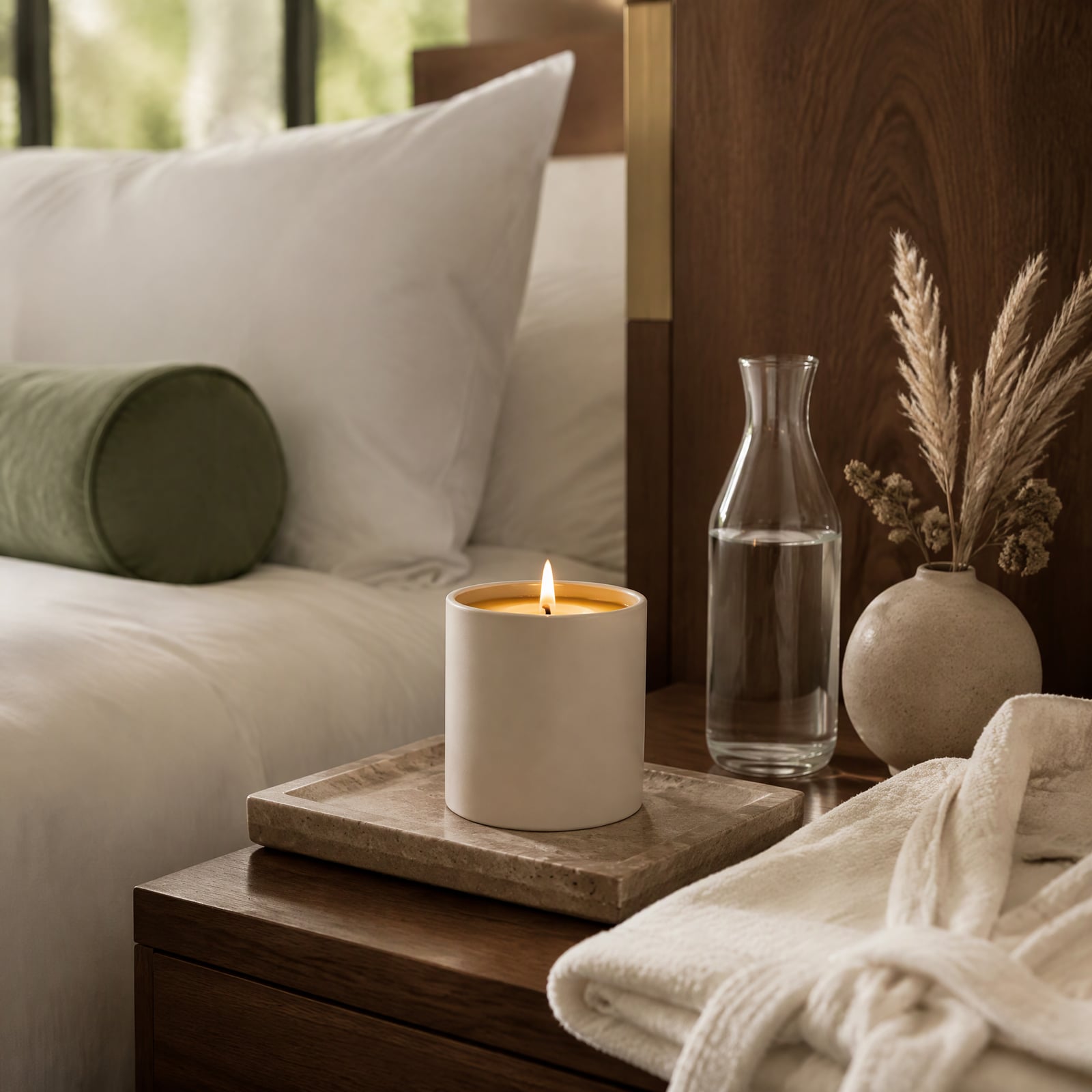
Walk into a boutique hotel in 2026 and you will notice something that would have been unusual a decade ago. Alongside the curated artwork, the single-origin coffee, and the linen curtains, there is often a candle—unlit, placed on a nightstand or a bathroom shelf, waiting for the guest to strike a match. And increasingly, that candle is made of beeswax.
This is not a coincidence, and it is not purely aesthetic. Over the past several years, boutique hotels have been quietly rethinking every object that enters a guest room, and the candle has moved from an afterthought to a deliberate decision. The reasons are practical, financial, and reputational—and they explain why beeswax has become the material of choice for a growing number of independent and design-led properties.
Historically, hotel candles served one purpose: ambiance. A taper on a dinner table, a pillar in a lobby, a votive near the bar. They were decorative props, replaced when they burned down, and rarely considered part of the guest experience itself.
That has changed. The in-room candle is now understood as part of a broader movement in hospitality toward what the industry calls "sensory design"—the deliberate use of scent, light, texture, and sound to shape how a guest feels during a stay. A candle left in a room is not merely decoration. It is an invitation. It tells the guest: this space was designed for you to slow down.
But once a hotel makes that invitation, the candle becomes a liability as well as an asset. A poorly made candle produces soot, stains surfaces, releases synthetic fragrance into a small enclosed room, and can generate complaints. A well-made candle does the opposite: it enhances the stay, reinforces the brand, and occasionally becomes the thing guests remember most.
This is where the choice of wax becomes decisive.
A hotel guest room is a small, sealed volume of air. Guests sleep in it, breathe in it, and often keep the windows closed for noise or climate control. Whatever a candle releases into that room is released into an environment with limited ventilation and long exposure time.
Most inexpensive hotel candles are made from paraffin wax, a byproduct of petroleum refining. Paraffin is inexpensive, holds fragrance and color well, and is easy to manufacture at scale. It is also the reason many people associate candles with headaches, coughing, or a faint chemical smell.
When paraffin burns, it can release volatile organic compounds (VOCs), including trace amounts of benzene and toluene. In a large, well-ventilated space this is a minor concern. In a guest room with the door closed and the air conditioning running on recirculation, it is a different matter—particularly for guests with asthma, allergies, or chemical sensitivities, who are disproportionately represented among the clientele of premium properties.
Pure beeswax behaves differently. It has the highest melting point of any common candle wax, approximately 62–64°C, which means it burns more slowly and more completely. With a properly trimmed wick, it produces virtually no soot. It does not stain walls, ceilings, or soft furnishings—an important consideration for hotels that repaint and refurbish on multi-year cycles.
Beeswax also releases negative ions as it burns. These bind to positively charged airborne particles such as dust, pollen, and dander, causing them to settle out of the air rather than remain suspended. For a hotel, this is a small but meaningful advantage in a room where guests are sleeping for eight hours.
Ask a hotel's executive housekeeper about candles, and the conversation quickly turns practical.
Soot stains. Paraffin candles produce black carbon deposits that settle on walls, ceilings, and fabric. In a room with white linens, light-colored walls, and designer furniture, soot is a visible maintenance problem. Beeswax, burned correctly, does not produce it.
Wax damage. Cheap candles drip. Wax on a wooden nightstand, a marble bathroom counter, or a linen runner means labor hours and, sometimes, permanent damage. Pure beeswax candles, when properly sized and burned in a draft-free location, are effectively dripless—which matters enormously when the candle is left for a guest to manage unsupervised.
Replacement frequency. Because beeswax burns significantly longer than paraffin of the same size—often 30 to 50 percent longer—a hotel replaces candles less often. The higher unit cost is partly offset by longer service life and fewer mid-stay replacements.
Breakage and packaging waste. Hotels are under increasing pressure to reduce single-use plastic and packaging waste. Many beeswax suppliers now offer plastic-free packaging, refillable vessels, or bulk formats that reduce the volume of material entering the waste stream.
Boutique hotels compete on distinctiveness. They cannot compete with large chains on price or loyalty programs, so they compete on the coherence of an experience—the sense that every detail has been chosen rather than inherited.
A beeswax candle is a strong signal in that conversation. It says the property cares about materials, about provenance, about what enters the guest's body and environment. It aligns with the values that boutique hotel guests increasingly expect: natural ingredients, minimal processing, environmental responsibility, and visible craft.
It also photographs beautifully. Beeswax has a warm, golden tone and a soft matte surface that reads as premium in a way that dyed paraffin rarely does. In an industry where guest-generated social media content is a primary marketing channel, this matters more than it might first appear.
There is a fragrance dimension as well. Pure beeswax carries a subtle natural honey aroma—warm, gentle, and entirely in keeping with a hotel that has chosen linen over polyester and oak over laminate. It does not compete with the room's other scents. It complements them, or disappears beneath them, which is often exactly what a well-designed guest room requires.
Sustainability in hospitality has moved past the era of the towel card. Guests now expect environmental claims to be specific and verifiable, and procurement teams are increasingly asked to document them.
Beeswax performs well on this front. It is a renewable resource, produced by honeybees as part of their natural lifecycle. It is harvested as a byproduct of honey production—specifically from the cappings that seal ripened honey cells—and ethical harvesting does not harm the colony.
It is also traceable. Reputable suppliers can identify the apiaries their wax comes from, and some can provide batch-level documentation. For hotels preparing sustainability reports or responding to guest questions, this level of traceability is a meaningful asset.
And it is circular in practice. Beeswax candles can be burned down almost completely, leaving minimal residue. The remaining wax can be repurposed. Many suppliers now offer refillable vessel programs, in which the hotel returns or refills glass or ceramic containers rather than discarding them. Several boutique properties have built guest-facing rituals around this—an evening turndown service that lights a beeswax candle, for example, with a card explaining what the candle is made from and how to extinguish it properly.
There is a reason hotels have begun to think of the candle as a service touchpoint rather than a decorative object.
Scent is the sense most directly connected to memory. Unlike sight or sound, smell reaches the brain's limbic system without first passing through the thalamus, which is why a particular fragrance can trigger a vivid memory faster than almost anything else. A hotel that establishes a distinctive scent in its rooms is not just creating ambiance—it is creating a memory anchor.
But here the choice of wax matters in a subtle way. Synthetic fragrance oils can produce a strong, consistent scent, but they often smell generic. Natural beeswax produces something quieter and more specific: a soft honey warmth that guests associate with the material itself rather than with a fragrance formula.
For hotels that want to be remembered, this is an advantage. A guest who lights the candle in their room at the end of an evening is participating in a small ritual—one that is repeated in every room of the property, creating a shared experience that is both personal and branded.
For hotel buyers considering a switch, several practical criteria matter:
Verify the beeswax content. A candle can legally be labeled "beeswax" with as little as 51 percent beeswax, with the remainder being paraffin. For the air quality and soot benefits to hold, look for 100 percent pure beeswax.
Check the wick. Lead-core wicks were banned in the United States in 2003, but imported candles may still contain them. Specify lead-free cotton wicks.
Confirm burn time and drip behavior. Ask for burn test data. A hotel cannot supervise how a guest burns a candle, so the candle must perform reliably unattended.
Consider the vessel. Glass and ceramic vessels can be refilled or repurposed. Consider whether the supplier offers a refill program.
Request batch documentation. For sustainability reporting and guest inquiries, traceability to the apiary level is a genuine differentiator.
Test in a real room. Burn the candle in an actual guest room with the door closed and the HVAC running. This is the only way to assess soot, fragrance intensity, and burn behavior under real conditions.
The most common objection from hotel procurement teams is cost. Pure beeswax candles are more expensive per unit than paraffin alternatives—sometimes significantly so.
The response is to calculate the true cost. A beeswax candle that burns 40 percent longer, produces no soot, requires no special cleaning, and does not need to be replaced mid-stay is often cheaper over the course of a year than a paraffin candle that appears inexpensive at the point of purchase. Add the brand value, the guest experience, and the sustainability documentation, and the economics become considerably more favorable.
Many boutique hotels have resolved the cost question by treating the candle as part of the room rate rather than as a consumable to be minimized. A single well-made beeswax candle, placed thoughtfully and replaced once per stay, costs a small fraction of the nightly rate and contributes disproportionately to how the stay is remembered.
The shift toward beeswax candles in boutique hotels is not a trend driven by aesthetics alone. It reflects a broader rethinking of what a guest room is for, what should enter it, and what a hotel wants to be remembered for.
Beeswax burns cleanly. It does not stain. It lasts longer. It carries a natural warmth that synthetic fragrance cannot replicate. It is renewable, traceable, and compatible with the sustainability commitments that boutique hotels increasingly make public.
And it does something that no spreadsheet captures: it makes a room feel cared for.
At [Insert Your Brand Name] , we supply 100 percent pure beeswax candles to boutique hotels, restaurants, and hospitality groups, with batch-level traceability, lead-free cotton wicks, and packaging designed to reduce waste. We work with properties to select formats and burn times suited to guest rooms, and we can develop custom vessels and seasonal scents for properties building a distinctive in-room ritual.
If your property is reconsidering its in-room candles, we would be glad to talk.
Waiting for our long-terms and friendly cooperation.

 EN


